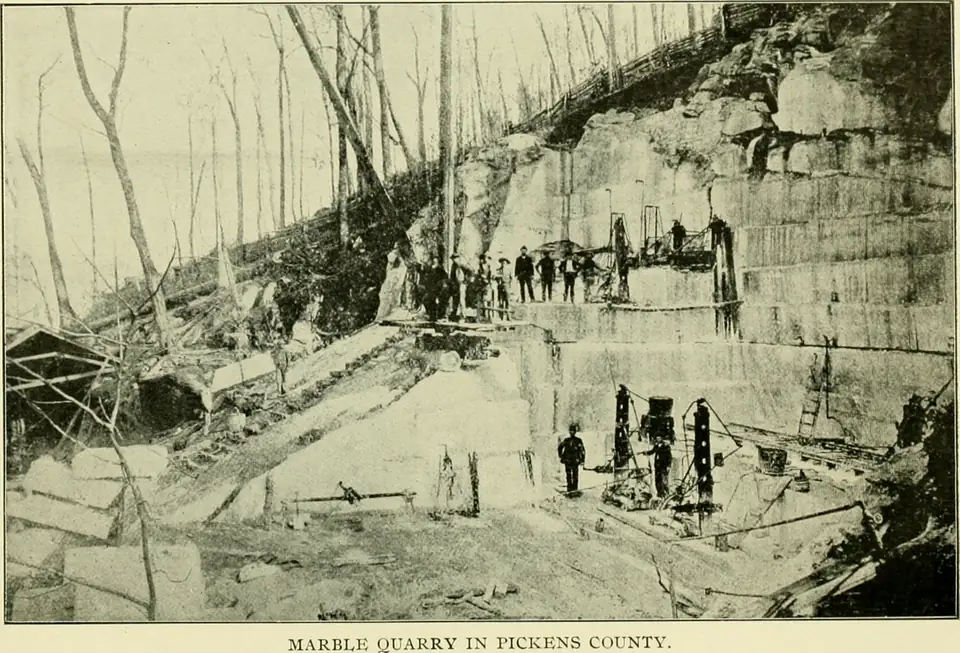
Georgia marble is a metamorphosed limestone quarried near Tate in Pickens County, Georgia, about 6 miles by road from Lee Newton Park in Jasper by our routing estimate (New Georgia Encyclopedia). People were carving it centuries before European settlement. Commercial quarrying started in the 1830s, the railroad arrived in 1883, and the Tate family founded the Georgia Marble Company in 1884. Where the sources disagree on a date or a claim, we say who says what.
The vein under Pickens County
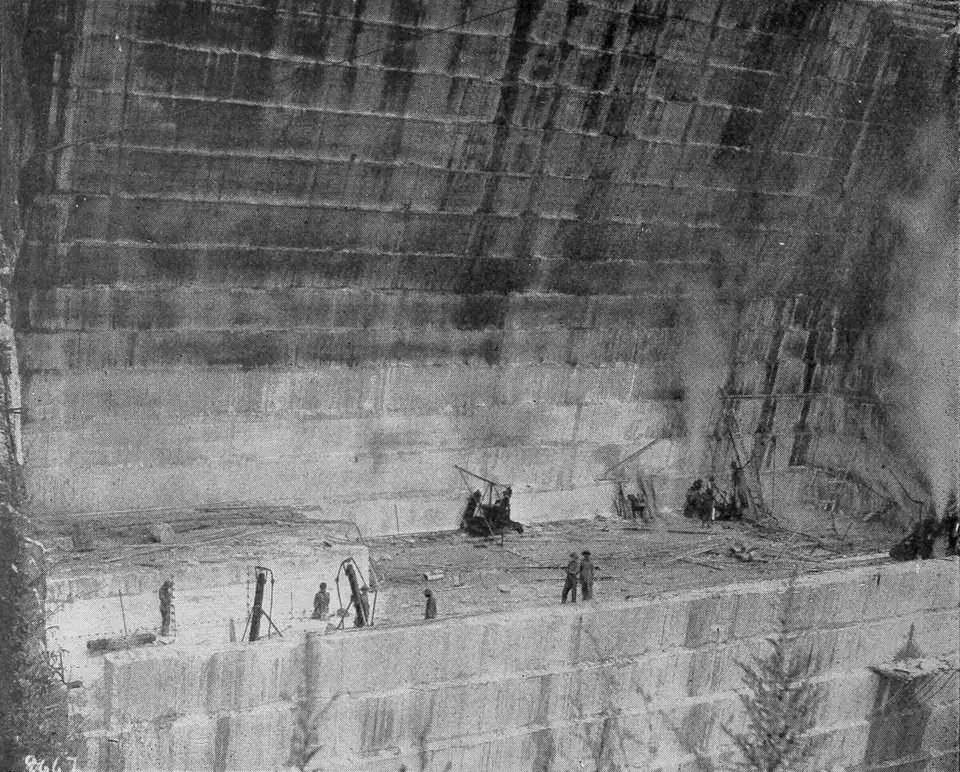
The Pickens County Chamber of Commerce says the marble vein runs 5 to 7 miles long, nearly half a mile wide and up to 2,000 feet deep (Visit Pickens), and calls the county “Georgia’s Marble Capital.” The National Register nomination for the Tate historic district says the quarries yield 30 kinds of marble, including the prized Etowah pink (National Register nomination). Polycor, which runs the Georgia Marble quarry in Tate today, sells varieties called White Cherokee, Etowah, Pearl Grey, Solar Grey and White Georgia (Polycor).
Before the quarries
The New Georgia Encyclopedia dates the earliest known use of Georgia marble to 1400, when native people carved effigies, bowls and projectile points from it. The Chamber puts Native American use much earlier, as early as 800 AD. We can’t settle that one, so read them as two sources’ positions. Early marble artifacts found in Pickens County are on permanent exhibit at Etowah Mounds near Cartersville.
The 1830s: Fitzsimmons, Long Swamp and Samuel Tate
The local industry began after the mid-1830s, when Irish stonemason Henry T. Fitzsimmons found surface marble in the Long Swamp Valley and opened the Long Swamp Marble Company. The valley was part of Cherokee County then. Pickens County itself wasn’t created until December 5, 1853, from parts of Gilmer and Cherokee counties (New Georgia Encyclopedia).
In the same decade, Samuel Tate bought land-lottery tracts with large marble deposits. In 1850 he became a partner in a marble company that opened a quarry near the present Georgia Marble Company site.
1883: the railroad
The Marietta and North Georgia Railroad reached Pickens County by 1883. In the encyclopedia’s account, it revived the marble industry by giving it a way to ship blocks and finished stone. Jasper boomed along with it, and cotton and marble became the basis of the town’s wealth (New Georgia Encyclopedia).
1884: the Georgia Marble Company
Backed by Northern capitalists, the Tate family created the Georgia Marble Company in 1884. The Georgia Historical Society marker in Tate says the company began that year as one of many small quarrying operations in the region (Georgia Historical Society). Its main office in Tate also dates from 1884, a Mission Revival building clad in white marble, according to the National Register nomination.
You’ll sometimes read that one man founded the company that year. The sources credit the family. Colonel Sam Tate became president in 1905 and led the company until his death in 1938.
Pink stone and a company town
The Etowah quarry opened in 1890 and produced the first truly pink marble, with Stephen and William Tate on its board. By 1900, 110 men worked in the marble industry in Tate. By 1924 the state geologist reported that $1,867,000 worth of marble had been quarried in Pickens County.
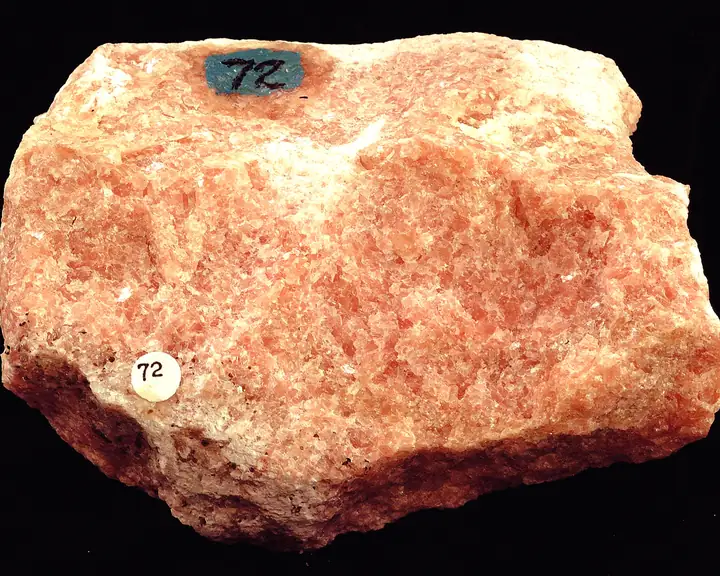
Tate grew up around its biggest employer. The company provided housing, recreational facilities and schools for workers and their families, and a company power plant made Tate the first electrified town in the area (Georgia Historical Society marker). Until about 1970, steel derricks hoisted blocks off the quarry floor, and the blocks average 12 to 20 tons.
The 1930s boom sent Georgia marble to the Longworth House Office Building, the Puerto Rican capitol, the New York Stock Exchange, and the Cleveland Federal Reserve Bank and Public Library. In Georgia, the encyclopedia lists the state capitol, Lenox Square Mall in Atlanta and several Emory University buildings.
What in Washington is really Georgia marble
This is where retellings stretch furthest, so here it is claim by claim.
| Claim | What the source says | Source |
|---|---|---|
| Lincoln Memorial | Only the statue is Georgia marble. The Piccirilli brothers carved it from 28 blocks of white Georgia marble in their New York studio. The exterior facade and upper steps are Colorado marble. | National Park Service |
| U.S. Capitol | Georgia marble clads the East Front connecting corridors. | Architect of the Capitol |
| The “24 columns” | The marker in Tate says the company’s stone is in the 24 columns on the Capitol’s east front. The Chamber adds that the marble columns replaced the original sandstone ones and were matched within one-tenth of an inch. We report these as the marker’s and the Chamber’s claims. | Georgia Historical Society marker; Visit Pickens |
| “60 percent of D.C. monuments” | The New Georgia Encyclopedia gives the figure, and its Pickens County article hedges it as “reportedly.” Treat it as a claim, not a count. | New Georgia Encyclopedia |

The photo above was taken in Washington, D.C., not Pickens County. It shows the one part of the Lincoln Memorial that came from Georgia.
The Lincoln Memorial's exterior facade and upper steps are Colorado marble, not Georgia marble; only the statue is Georgia marble. (NPS, checked Oct 18, 2026)
The longer version is in our article on Georgia marble in Washington.
From building stone to ground marble
The company’s Calcium Products Division, selling ground and pulverized marble, began in 1947 and was the primary product by the late 1980s. The Chamber says Georgia marble even goes into toothpaste, though it names no brands.
Ownership changed several times. The Jim Walter Corporation bought the Georgia Marble Company in 1969 for $23 million, and later owners included IMERYS. The encyclopedia says Polycor Inc. of Quebec City bought the company in 2003. Polycor describes the deal more narrowly, as buying the dimension-stone division from Imerys, and Imerys still appears among the Chamber’s quarry-tour supporters. In July 2005 Polycor announced Tate would be its U.S. headquarters; we have not confirmed whether that is still true.
Quarry-to-monument timeline
- 1400
Carved by early hands
The New Georgia Encyclopedia dates the earliest known use of Georgia marble to about 1400, when native people carved effigies, bowls and points. (New Georgia Encyclopedia)
- 1830s
Long Swamp
Irish stonemason Henry T. Fitzsimmons found surface marble in the Long Swamp Valley and opened the Long Swamp Marble Company. (New Georgia Encyclopedia)
- 1883
The railroad arrives
The Marietta and North Georgia Railroad reached Pickens County and gave the quarries a way to ship stone. (New Georgia Encyclopedia)
- 1884
The Georgia Marble Company
With investment from Northern capitalists, the Tate family created the Georgia Marble Company. (New Georgia Encyclopedia)
- 1890
The first true pink
The Etowah quarry opened and produced the first truly pink marble. (New Georgia Encyclopedia)
- 1905
Colonel Sam Tate
Sam Tate became the company's president and served until his death in 1938. (Georgia Historical Society)
- 1930s
Boom years
Georgia marble went into the Longworth House Office Building, the New York Stock Exchange and the Cleveland Federal Reserve Bank. (New Georgia Encyclopedia)
- D.C.
The Lincoln statue
The Piccirilli brothers carved the Lincoln statue from 28 blocks of white Georgia marble. The memorial's exterior is Colorado marble. (NPS)
- 1947
Marble, ground fine
The company's calcium products division began, and ground marble became its main product by the late 1980s. (New Georgia Encyclopedia)
- 2003
New owners
Polycor Inc. of Quebec City, Canada, bought the company, according to the New Georgia Encyclopedia. (New Georgia Encyclopedia)
- 2026
The 44th festival
Jasper celebrated the stone with the 44th Georgia Marble Festival on October 3 and 4, 2026. (Visit Pickens)
See it for yourself
Start at the Georgia Marble Museum, which shares space with the Pickens County Visitor Center inside Lee Newton Park, 500 Veterans Memorial Blvd in Jasper. The Chamber lists it as open Monday through Friday, 8:30 a.m. to 4:00 p.m. (Visit Pickens); the tourism site’s footer says 9 to 4, so call (706) 692-5600 before you drive over. The exhibits connect local marble to landmarks around the country.
Then drive the Tate marble trail on GA 53 for the historical marker, the company district and the Tate Depot. The quarries are private. The Chamber says they open for guided tours once a year, during the Georgia Marble Festival, and our quarry tours page explains how the 2026 tours worked. The Chamber says the festival is held the first full weekend of October; it has not announced 2027 dates (checked October 18, 2026). For the village and the mansion, read Tate, the marble company town and the Tate House.
Marble places to see
Museum and visitor center
Pickens County Visitor Center & Georgia Marble Museum (Pickens County Chamber of Commerce)
The official visitor center, inside Lee Newton Park, with free maps and guides. Also houses the Georgia Marble Museum's exhibits on Pickens County's marble history. The festival organizer's office.
- Mon-Fri 8:30am-4:00pm (Chamber 'Our Hours' and Marble Museum listing). The VisitPickensGA.com footer says Mon-Fri 9-4.
- 500 Veterans Memorial Blvd, Jasper, GA 30143
- (706) 692-5600
Source: Visit Pickens (Chamber), checked Oct 18, 2026
Historic site
Pickens County Courthouse
Two-story, marble-veneered Stripped Classical courthouse (the NRHP form gives both 1949 and 1947). Working government building; no visitor hours published.
- 50 N. Main St., Jasper, GA 30143
Source: National Register (NPS), checked Oct 18, 2026
Historic site
Old Pickens County Jail
1906 jail (used until 1982) with a rusticated marble front, porch columns and turrets; marble from the Southern Mill in Marble Hill. Listed by the Chamber under History & the Arts. Tour hours not verified.
- 141 N Main St, Jasper, GA 30143
Source: Visit Pickens (Chamber), checked Oct 18, 2026
Historic site
The Tate House (Pink Marble Mansion / 'Pink Palace')
Colonel Sam Tate's Etowah pink-marble mansion from the 1920s. Now a privately owned, adult-only wedding venue, open to the public only during its annual Christmas Open House.
- Not open for drop-in tours. 2026 Christmas Open House tour-only: Mon-Sat 11:00am-1:30pm, tickets sold Dec 1-23, 2026. Group luncheon tours (50+) Mon-Thu 11am-2pm by booking.
- Christmas tour-only: $25 adults, $5 children 10 & under. Christmas Lunch Tour $68 (2026).
- 61 Marble Mansion Ln, Tate, GA 30177
- 770-735-3122
Source: tatehouse.com, checked Oct 18, 2026
Historic site
Georgia Marble Company and Tate Historic District
The company village of Tate and the Georgia Marble Company complex (1884 marble main office; quarries yielding 30 kinds of marble including Etowah pink). The quarries are private; the public sees them only on Marble Festival quarry tours.
- Centered on GA 53 between GA 5 and Long Swamp Creek, Tate, GA 30177
Source: National Register (NPS), checked Oct 18, 2026
Historic site
Historical marker: Georgia Marble Company and the Village of Tate
Georgia Historical Society marker erected in 1999, covering the company's 1884 start, Colonel Sam Tate, the company town and Tate's early electrification.
- Tate Cemetery, on GA 53, Tate, GA
Source: georgiahistory.com, checked Oct 18, 2026
Town
Nelson
Incorporated city on the Cherokee County line, site of the Georgia Marble Company finishing plant on the former John Nelson property.
- Nelson, GA
Source: Visit Pickens (Chamber), checked Oct 18, 2026
Quarry (private)
Polycor (Georgia Marble) plant and quarry, Tate
Polycor's Georgia Marble quarry operation in Tate (White Cherokee, Etowah and other varieties). Private and not open to visitors; Polycor-Georgia Architectural Stone supports the festival quarry tours.
- Tate, GA 30177
Source: polycor.com, checked Oct 18, 2026
Questions people ask
When was the Georgia Marble Company founded?
The Tate family created the Georgia Marble Company in 1884, backed by Northern capitalists, according to the New Georgia Encyclopedia. Colonel Sam Tate became its president later, in 1905.
Source: New Georgia Encyclopedia, Marble, checked Oct 18, 2026
Is the Lincoln Memorial made of Georgia marble?
Only the statue. The National Park Service says the Lincoln statue was carved from 28 blocks of white Georgia marble, while the memorial's exterior facade and upper steps are Colorado marble.
Source: NPS, checked Oct 18, 2026
Is the U.S. Capitol built with Georgia marble?
Part of it. The Architect of the Capitol says Georgia marble clads the Capitol's East Front connecting corridors. The historical marker in Tate also credits Georgia Marble Company stone with the 24 columns on the east front.
Source: Architect of the Capitol, Marble, checked Oct 18, 2026
How big is the Georgia marble vein?
The Pickens County Chamber of Commerce says the vein under Pickens County runs 5 to 7 miles long, nearly half a mile wide and up to 2,000 feet deep.
Source: Visit Pickens, checked Oct 18, 2026
Where can I see Georgia marble history in Jasper?
At the Georgia Marble Museum, which shares space with the Pickens County Visitor Center at 500 Veterans Memorial Blvd. The Chamber lists it as open Monday to Friday, 8:30 a.m. to 4:00 p.m.; call (706) 692-5600 first, since the tourism site footer says 9 to 4.
Source: Visit Pickens, checked Oct 18, 2026
Who owns the Georgia Marble Company quarries today?
Polycor says it bought the Georgia Marble Company's dimension-stone division from Imerys, and it places its Georgia Marble quarry in Tate. Imerys still appears among the festival's quarry-tour supporters, so one company owning all of it isn't supported.
Source: Polycor, Georgia Marble Company, checked Oct 18, 2026