Partly. The National Park Service says the statue of Abraham Lincoln inside the Lincoln Memorial was carved from Georgia marble. The building around him is another matter: its outside facade and upper steps are Colorado marble. That difference tends to get lost in the retelling around Jasper, Georgia, so this is a source-by-source check of what stone from the marble country really went to Washington, and which of the bigger claims hold up.
The Lincoln statue: yes, and the Park Service says so
The National Park Service credits the carving to the Piccirilli brothers. In the Park Service’s words, the brothers, in their New York studio, “transformed 28 blocks of white Georgia marble into intricately carved pieces that French himself perfected.”
The same page says where the rest of the memorial came from: “The granite at the terrace level came from Massachusetts, the marble of the upper steps and outside façade came from Colorado, while the pink marble floor of the chamber came from Tennessee.” So the man in the chair is Georgia. The building is mostly somewhere else.

That photo was taken in Washington, not Pickens County. It shows the one part of the memorial the Park Service credits to Georgia.
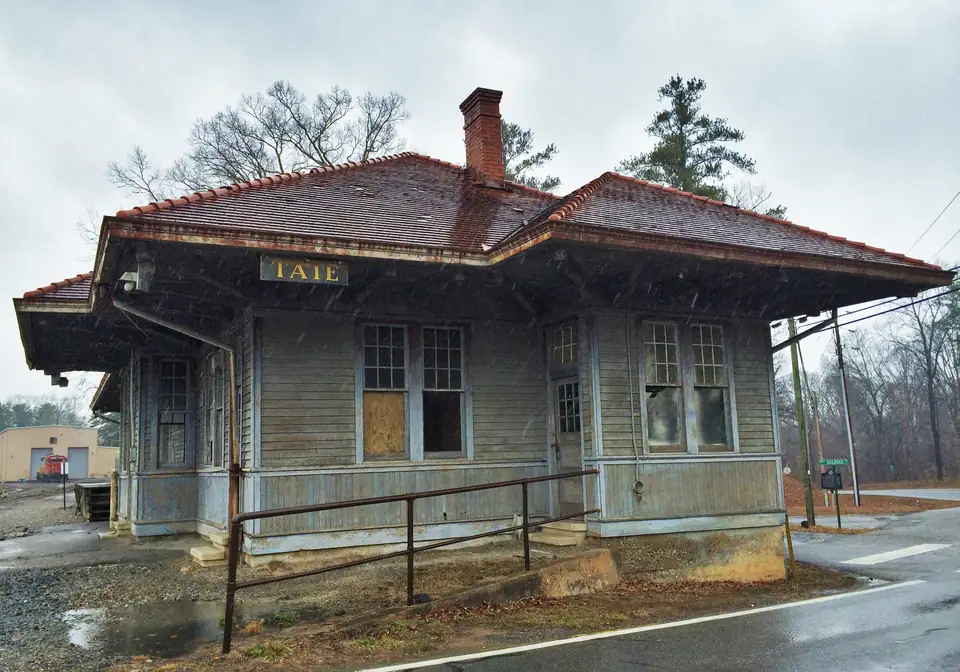
One more honest note. The Park Service passage we checked says “white Georgia marble” and stops there. The link to Pickens County comes from the Georgia Historical Society marker in Tate, which says Georgia Marble Company stone “can be found in monuments and public buildings around the world, including the Lincoln Memorial.” Read side by side, the fair version is this: the statue is Georgia marble, and the state’s historical marker credits the Georgia Marble Company.
The U.S. Capitol: corridors on the record, columns on a marker
The Architect of the Capitol says “Georgia marble clads the East Front connecting corridors.” That is the cleanest primary-source line we found about the Capitol, and it is narrower than what you may hear on the courthouse square.
The historical marker goes further. It lists “the twenty-four columns on the east front of the U.S. Capitol.” The Chamber’s VisitPickensGA.com goes further still, saying Georgia marble columns replaced the Capitol’s original sandstone columns and had to match the originals within one-tenth of an inch (Visit Pickens). We could not confirm the column count or that tolerance on the Architect of the Capitol’s marble page, which talks about the corridors. Treat both as claims made by state and local sources, not settled fact.
The 60 percent line
You will hear that most of the monuments in Washington are Georgia marble. The New Georgia Encyclopedia article on Pickens County handles it carefully: marble from the county went into major public buildings across the country “and, reportedly, in 60 percent of the monuments in Washington, D.C.” The encyclopedia’s own word there is “reportedly.” None of the sources we read shows the count behind the number. It is a figure people repeat, and we would not carve it on a plaque.
What else is on the record
The encyclopedia’s Marble article names one more Washington building. During the marble boom of the 1930s, Georgia marble went into the Longworth House Office Building in Washington, along with the Puerto Rican capitol, the New York Stock Exchange, and the Cleveland Federal Reserve Bank and Public Library in Ohio. Closer to home, native marble was used on the Georgia State Capitol, Lenox Square Mall in Atlanta and several Emory University buildings.
The scorecard
| Claim you will hear | What the source says | Our read |
|---|---|---|
| The Lincoln Memorial is Georgia marble | The statue is 28 blocks of white Georgia marble; the facade and upper steps are Colorado marble (National Park Service) | Statue yes, building no |
| Georgia marble is on the U.S. Capitol | It clads the East Front connecting corridors (Architect of the Capitol) | On the record |
| Twenty-four Capitol columns are Georgia marble | Stated on the 1999 marker in Tate (Georgia Historical Society) | Attributed, count not confirmed |
| The columns matched the originals within a tenth of an inch | Stated on VisitPickensGA.com (the Chamber) | Unverified |
| 60 percent of D.C. monuments | “Reportedly” (New Georgia Encyclopedia) | Hedged by its own source |
| Longworth House Office Building | Named among 1930s jobs (New Georgia Encyclopedia) | On the record |
Where the stone comes from
Georgia marble is a metamorphosed limestone quarried near Tate in Pickens County, per the encyclopedia. The Chamber says the vein under the county runs 5 to 7 miles long, nearly half a mile wide and up to 2,000 feet deep. The industry took off after the Marietta and North Georgia Railroad reached the county by 1883, and the Tate family created the Georgia Marble Company in 1884. Our Georgia marble history page tells the long version, and the company village itself is in our piece on Tate, the company town.
- 1400
Carved by early hands
The New Georgia Encyclopedia dates the earliest known use of Georgia marble to about 1400, when native people carved effigies, bowls and points. (New Georgia Encyclopedia)
- 1830s
Long Swamp
Irish stonemason Henry T. Fitzsimmons found surface marble in the Long Swamp Valley and opened the Long Swamp Marble Company. (New Georgia Encyclopedia)
- 1883
The railroad arrives
The Marietta and North Georgia Railroad reached Pickens County and gave the quarries a way to ship stone. (New Georgia Encyclopedia)
- 1884
The Georgia Marble Company
With investment from Northern capitalists, the Tate family created the Georgia Marble Company. (New Georgia Encyclopedia)
- 1890
The first true pink
The Etowah quarry opened and produced the first truly pink marble. (New Georgia Encyclopedia)
- 1905
Colonel Sam Tate
Sam Tate became the company's president and served until his death in 1938. (Georgia Historical Society)
- 1930s
Boom years
Georgia marble went into the Longworth House Office Building, the New York Stock Exchange and the Cleveland Federal Reserve Bank. (New Georgia Encyclopedia)
- D.C.
The Lincoln statue
The Piccirilli brothers carved the Lincoln statue from 28 blocks of white Georgia marble. The memorial's exterior is Colorado marble. (NPS)
- 1947
Marble, ground fine
The company's calcium products division began, and ground marble became its main product by the late 1980s. (New Georgia Encyclopedia)
- 2003
New owners
Polycor Inc. of Quebec City, Canada, bought the company, according to the New Georgia Encyclopedia. (New Georgia Encyclopedia)
- 2026
The 44th festival
Jasper celebrated the stone with the 44th Georgia Marble Festival on October 3 and 4, 2026. (Visit Pickens)
See the stone without driving to Washington
The Georgia Marble Museum shares space with the Pickens County Visitor Center at 500 Veterans Memorial Blvd in Jasper, with exhibits tying local marble to landmarks around the country. The Chamber lists its hours as Monday to Friday, 8:30 a.m. to 4 p.m.; its tourism site’s footer says 9 to 4, so call (706) 692-5600 before a trip. The Georgia Historical Society marker stands in Tate Cemetery on GA 53, and our Tate marble trail strings it together with the other stops.
If you want to stand at the edge of the source, the public gets one chance a year: the Chamber’s guided quarry tours during the Georgia Marble Festival. Dates for 2027 have not been announced.
Questions people ask
Is the Lincoln Memorial made of Georgia marble?
Only the statue. The National Park Service says the Piccirilli brothers carved Lincoln from 28 blocks of white Georgia marble, while the memorial's outside facade and upper steps came from Colorado.
Source: National Park Service, checked Oct 18, 2026
Is Georgia marble on the U.S. Capitol?
Yes, in part. The Architect of the Capitol says Georgia marble clads the Capitol's East Front connecting corridors. A Georgia Historical Society marker in Tate also credits the company's stone with 24 east front columns.
Source: Architect of the Capitol, checked Oct 18, 2026
Are 60 percent of Washington, D.C. monuments made of Georgia marble?
That figure is unproven. The New Georgia Encyclopedia's Pickens County article says Pickens County marble went into, reportedly, 60 percent of the monuments in Washington, D.C., and hedges it with that word.
Source: New Georgia Encyclopedia, checked Oct 18, 2026
Where can I see Georgia marble history in Jasper, GA?
The Georgia Marble Museum shares space with the Pickens County Visitor Center at 500 Veterans Memorial Blvd in Jasper, open Monday to Friday, 8:30 a.m. to 4 p.m. per the Chamber. Call (706) 692-5600 to confirm hours.
Source: Visit Pickens, checked Oct 18, 2026
Written by the Jasper Marble Festival Guide Editorial Team. AI tools help us draft; people check every fact before it publishes.